Can you put a washing machine in a cabinet?
Yes, you can put a washing machine in a cabinet. In fact, a well-designed washing machine cabinet offers not only a tidy look but also more comfort through less bending, better stability and clever storage. What matters is that the cabinet is designed specifically for the weight and vibration of a washing machine, with enough ventilation and room for the connections. Washtower® washing machine cabinets are made exactly for that.
What to consider with a washing machine in a cabinet
When you put a washing machine in a cabinet, a few practical points make the difference between a safe, comfortable setup and a construction that causes problems:
Ventilation: a washing machine produces heat and moisture. All our washing machine cabinets therefore come with a ventilation grille as standard, so air can circulate optimally and condensation is prevented.
Room for connections: leave at least 5 to 10 cm free behind the washing machine for water hoses, the drain and the power cable. Washtower® washing machine cabinets have about 5 cm of space in the cabinet itself for the connections. With the wall brackets you can place the cabinet another 5 cm from the wall, which leaves ample room for all the connections.
Stability and vibration: a washing machine vibrates during the spin cycle. A cabinet must therefore be sturdy and able to absorb vibration well. With Washtower® washing machine cabinets, vibration is directed downwards through the distinctive cabinet-in-cabinet construction, which makes for stable, quiet operation.
Level placement: make sure the base plate the machine stands on is completely level. Then screw the washing machine's feet fully into their fixed base position. This prevents walking and excessive vibration.
Access: make sure you can always reach the tap, the socket and the drain for maintenance or emergencies.
What options are there for a washing machine cabinet?
There are several ways to put a washing machine in a cabinet. Each option has its own advantages and drawbacks:
A purpose-designed washing machine cabinet
Advantages: Built for weight and vibration, safe construction with an anti-tip device, modular and expandable, ergonomic
Drawbacks: A bigger investment than building it yourself
A self-built surround
Advantages: Cheaper, made to measure
Drawbacks: Often not stable enough, no allowance for vibration, no safety features
Built into a kitchen unit
Advantages: Hidden away, a sleek look
Drawbacks: Limited ventilation, often too little room for connections, not suitable for every washing machine
Washtower® washing machine cabinets can be adapted entirely to your own space and needs. They have a continuous base plate that spreads the weight well, a distinctive cabinet-in-cabinet construction for extra stability, and ventilation grilles as standard. You can also extend them modularly with handy storage cabinets for all your laundry essentials, a dryer on the washing machine or a washer and dryer cabinet for two machines side by side.
Does a standard washing machine fit in a washing machine cabinet?
Yes, most standard washing machines fit in a washing machine cabinet without trouble. The recess of Washtower® washing machine cabinets is 62.5 x 86.3 x 58.3 cm (width x height x depth). That is ample for virtually all freestanding washing machines, which average 60 cm wide, 85 cm high and 55 to 60 cm deep.
Bear in mind that you are left with about 1 to 2 cm at the sides and 3 to 5 cm above the machine. This gives the machine enough clearance for the heat it gives off.
Why a washing machine cabinet with a raised base?
A washing machine cabinet with a raised base always offers considerably more comfort. By putting the washing machine at a height of about 60 cm, you never have to bend deeply again when loading and unloading. That is always a very welcome improvement to your daily laundry routine, whether you want to prevent back and knee complaints or simply work ergonomically.
Storage also appears under the washing machine. You can keep detergent, laundry baskets or other laundry essentials there. Have a look at the washing machine stands for more about this option.
Can a washing machine go in a cabinet together with a dryer?
Yes, in several ways. The most common setups are:
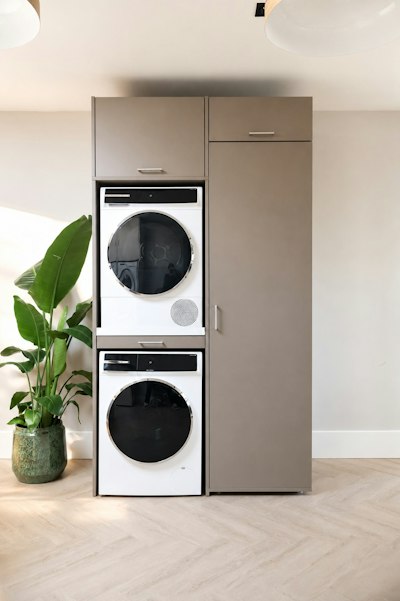
Dryer on washing machine: the dryer goes on top of the washing machine in a tower. This saves floor space and is ideal for small rooms. Washtower® washing machine cabinets have an anti-tip device as standard, so the dryer stays safely in place.
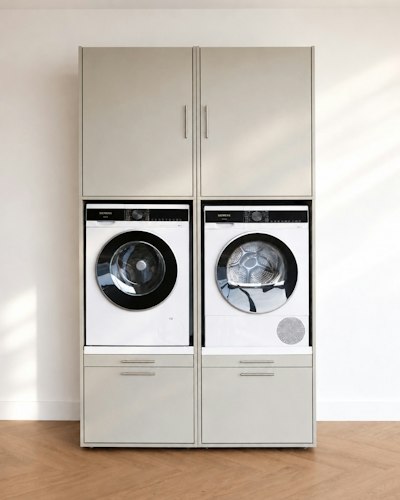
Side by side: with a washer and dryer cabinet you place both appliances next to each other at the same height. This is more comfortable ergonomically and gives a better overview.
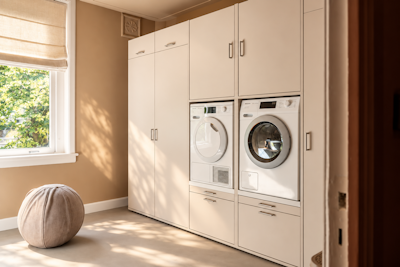
A modular setup: you can extend the washing machine cabinet with storage cabinets for a complete laundry room with enough storage for detergent, towels and cleaning products.
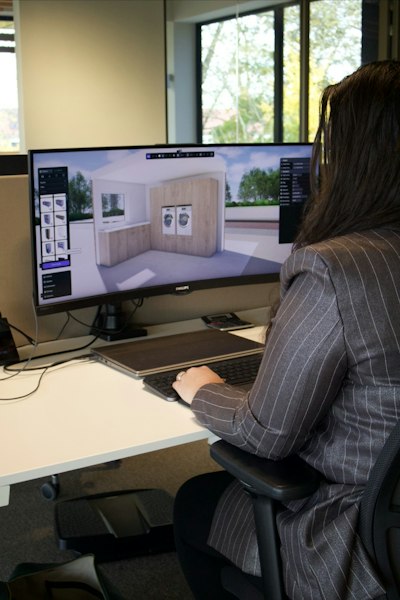
Would you like to put a setup together yourself? Then use the configurator to see which combination suits your space best.
What makes a washing machine cabinet safe?
Safety starts with a sturdy construction. Washtower® washing machine cabinets have a distinctive cabinet-in-cabinet construction, in which the washing machine stands in the cabinet on a continuous base plate. This base plate spreads the weight evenly and makes sure vibration is directed straight down through the construction rather than out to the sides.
Every washing machine cabinet also has an anti-tip device. This stops a dryer on a washing machine tipping forwards, even when opening the door or under a heavy load.
Finally, ventilation is essential. The ventilation grilles fitted as standard make sure heat and moisture can escape quickly, which prevents mould and overheating.
How do you level a washing machine in a cabinet?
A level washing machine vibrates less and runs more quietly. Here is how to level it:
Use a spirit level: put a spirit level on the base plate where the washing machine will stand, both left to right and front to back. Use the adjustable feet of the cabinet to get the base plate completely level
Adjust the feet: screw the feet under the washing machine all the way up into their fixed base position. That way you know for certain it is 100% level when you put it in the cabinet.
Check again: run an empty wash at a high spin speed and check that the machine does not walk or vibrate excessively. You can also tell by looking at the gap to the left and right of the machine: is there as much space at the top as at the bottom? Then it is almost certainly level.
A properly levelled washing machine in a sturdy cabinet means less noise and a longer life for both the machine and the cabinet.
What is the difference between an ordinary cabinet and a washing machine cabinet?
An ordinary cabinet is not designed to absorb the weight and vibration of a washing machine. A washing machine weighs 60 to 80 kilos on average and generates considerable forces during the spin cycle. The side panels of a standard cabinet can be pushed outwards as a result, or even creak or crack.
A washing machine cabinet, by contrast, has:
A reinforced construction: thicker panels and a distinctive cabinet-in-cabinet build for optimal stability.
A continuous base plate: this spreads the weight evenly and directs vibration straight downwards.
Ventilation grilles: built in as standard for good air circulation and moisture removal.
An anti-tip device: stops a dryer or washing machine tipping over.
Room for connections: the cabinet has room for connections and can be placed away from the wall, so there is enough space for hoses and cables.
Have a look at the full range of washing machine cabinets to see what the options are.
Can you put a washing machine cabinet together yourself?
Yes, with the Washtower® online configurator you easily put your ideal laundry room together. You choose:
Type of cabinet: a stand, a tower for a dryer on a washing machine, a double cabinet or a complete cabinet wall.
Colour and finish: various colours and materials to match your interior.
Extra storage: add storage cabinets for detergent, towels or a place for the vacuum cleaner.
Accessories: think of pull-out laundry baskets, handy inserts or specific layout modules.
The configurator immediately shows a visual of your setup and calculates the price. So you know straight away what is possible within your budget and space.
How do you stop a washing machine in a cabinet vibrating too much?
Vibration is normal with a washing machine, but you can prevent excessive vibration by:
Levelling it: screw the feet under the washing machine all the way up into their fixed base position. Make sure the base plate the machine stands on is completely level. That way you know for certain it is 100% level when you put it in the cabinet.
Removing the transit bolts: new washing machines have transit bolts that absorb vibration during transport. Do not forget to remove them before the first use.
Distributing the laundry evenly: do not put too much or too little washing in the drum, and make sure it is evenly distributed.
A firm base: Washtower® washing machine cabinets have a continuous base plate that directs vibration downwards through the cabinet-in-cabinet construction, which makes for stable operation.
Are you dealing with a vibrating washing machine? Then also read the article on how to dampen vibration and noise.
What are the advantages of a washing machine cabinet?
A washing machine cabinet offers more than just a tidy look. The main advantages are:
More comfort: by putting the washing machine at a comfortable height, you have to bend less deeply. That is kinder to your back and knees.
Space saving: with a tower for a dryer on a washing machine, or a double cabinet, you make the most of the space available.
Extra storage: under, beside or above the washing machine there is room for detergent, laundry baskets and other essentials.
Safety: an anti-tip device stops a dryer on a washing machine tipping over. The sturdy construction absorbs vibration well.
Quiet operation: vibration is directed downwards through the distinctive cabinet-in-cabinet construction, so the washing machine runs more quietly.
Modular and expandable: you can extend the setup flexibly later with extra storage cabinets or a second machine.
How do you choose the right washing machine cabinet?
The right washing machine cabinet depends on your situation. Ask yourself the following questions:
How much space do you have? measure the available width, height and depth of your laundry room. Allow room for opening doors and flaps.
Do you also have a dryer? then choose a tower or a double cabinet, depending on your preference and the space available.
Would you like extra storage? add storage cabinets to your setup for a complete laundry room.
What is your budget? the configurator shows straight away what the various options cost, so you can make a choice that fits your budget.
Still unsure? Then request personal advice. Our specialists are happy to help you make the right choice.
Do you have questions or would you like personal advice? Contact our customer service or put your ideal solution together easily using our online configurator.